Made to Order
On-Demand Printing
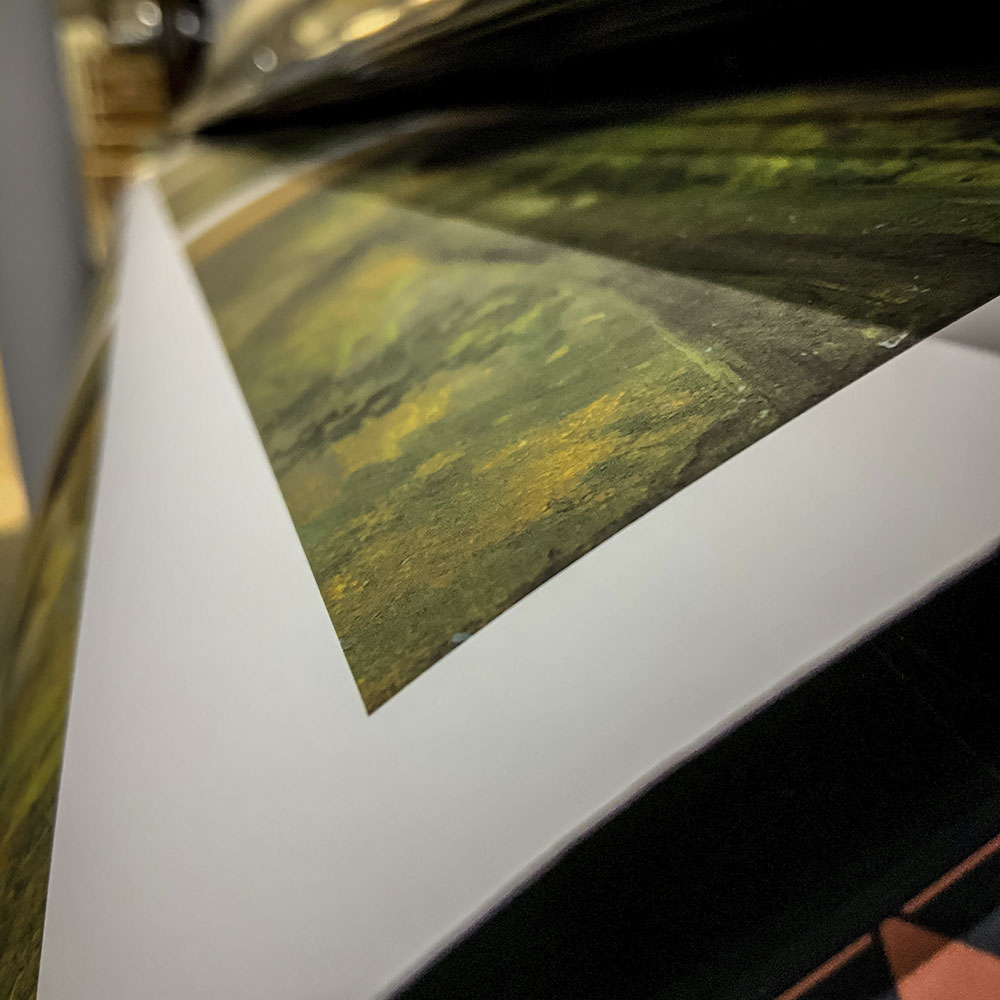
All products are produced on-demand, in accordance with stringent production protocols designed to ensure consistent and superior quality.


Although Kandinsky was forced to leave Germany in 1933 due to political pressures, he did not allow the mood of desolation pervading war-torn Europe to enter the paintings and watercolors that he produced in France, where he remained until his death in 1944. His late works are marked by a general lightening of palette and the introduction of organic imagery; breaking away from the rigidity of Bauhaus geometry, he turned to the softer, more malleable shapes used by Paris-based artists associated with Surrealism, such as Jean Arp and Joan Miró. Kandinsky’s late, often whimsical, paintings were also influenced by the playful, intricately detailed compositions of his longtime friend and Bauhaus colleague Paul Klee.
During his first years in France, Kandinsky experimented with pigments mixed with sand, a technical innovation practiced during the 1930s by many Parisian artists, including André Masson and Georges Braque. Although Kandinsky utilized this method only until 1936, he created several paintings with rich, textured surfaces such as Accompanied Contrast, in which the interconnected colored planes and smaller floating patterns project slightly from the canvas. Always attentive to and appreciative of contemporary stylistic innovations, Kandinsky inevitably brought his own interests to bear on any aspects he would borrow. As art historian Vivian Barnett has pointed out, his employment of biomorphic forms—a motif favored by Surrealist painters as well as by Klee—attests more to his fascination with the organic sciences themselves, particularly embryology, zoology, and botany. During his Bauhaus years, Kandinsky had clipped and mounted illustrations of microscopic organisms, insects, and embryos from scientific journals for pedagogical purposes and study. He also owned several important sourcebooks and encyclopedias from which depictions of minuscule creatures found abstract equivalences in his late paintings. A schematized pink-toned embryo, for instance, floats in the upper-right corner of Dominant Curve, while the figures contained within the green rectangle in the upper-left corner resemble microscopic marine animals. Various Actions is imbued with similar organic figures hovering above a celestial blue field. These buoyant, biomorphic images, often presented in pastel hues, may be read as signs of Kandinsky’s optimistic vision of a peaceful future and hope for postwar rebirth and regeneration.
Nancy Spector