Made to Order
On-Demand Printing
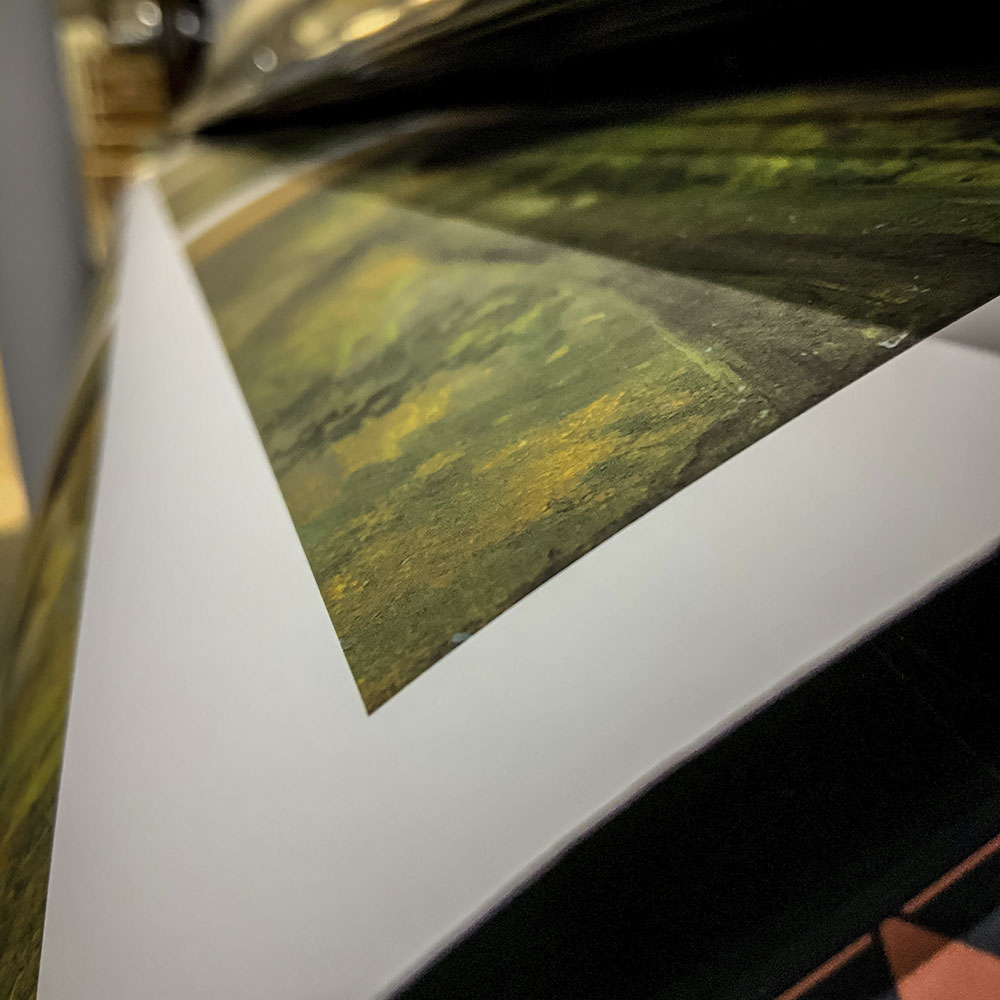
All products are produced on-demand, in accordance with stringent production protocols designed to ensure consistent and superior quality.


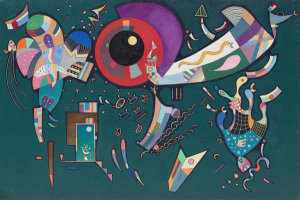
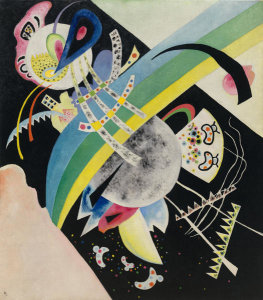
Vasily Kandinsky was forced to leave Germany and the Bauhaus school of art, architecture, and design due to political pressures during World War II, but he did not allow the mood of desolation pervading war-torn Europe to manifest in his paintings. The canvases and works on paper he completed during his 1934–44 residence in Neuilly-sur-Seine are marked by a general lightening of palette and the introduction of organic, even biological, forms.
Capricious Forms is a product of the artist at perhaps his most playful moment: interspersed with the clearly delineated circles and squares—the fundamental geometric shapes of his Bauhaus works—are floating and dancing curvilinear figures, all rendered in pastel shades. Several forms can be interpreted as stylized representations of embryo-shaped figures. Additional shapes resemble scientific illustrations of placental tissue, with which Kandinsky (who collected embryological, zoological, and botanical sourcebooks) was undoubtedly familiar. The biological imagery may be read as the artist’s optimistic vision for a not-too-distant future of rebirth and regeneration.
Nancy Spector